
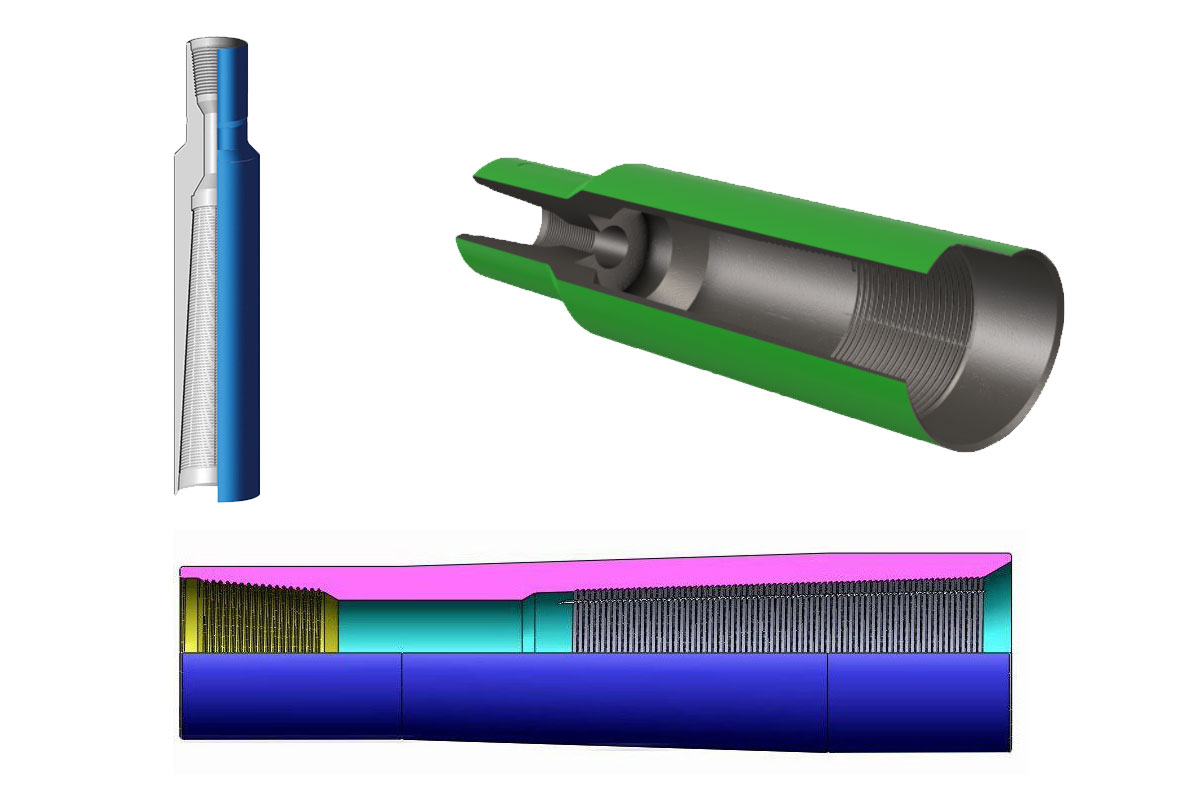
Fishing operations in deviated and horizontal wells present significant mechanical and operational challenges. As well trajectories become increasingly complex in modern drilling programs, conventional fishing tools—particularly die collars—must evolve to ensure higher engagement reliability, torque transmission efficiency, and operational safety.
Recent advances in die collar design for fishing operations in deviated wells have significantly improved performance under high side-load conditions, irregular contact geometry, and restricted wellbore access. This article explores the latest technological improvements, engineering considerations, and field performance enhancements that are transforming die collar efficiency in complex well profiles.
Understanding the Role of Die Collars in Fishing Operations
A die collar is a rotary internal catch tool designed to engage the external surface of a fish (typically drill pipe, tubing, or tool joints) by cutting threads into it using hardened dies. Once engaged, the tool allows operators to apply torque and pull loads to retrieve the stuck or lost equipment.
In vertical wells, alignment between the die collar and the fish is relatively straightforward. However, in deviated and horizontal wells, several additional complications arise:
Gravity-induced side loading
Limited tool centralization
Reduced rotational efficiency
Irregular fish orientation
Increased friction and drag forces
Restricted hydraulic circulation
These challenges demand enhanced die collar designs capable of operating reliably under non-ideal alignment conditions.
Key Challenges in Deviated Well Fishing
1. Tool Misalignment and Eccentric Loading
In high-angle wells, the die collar often contacts the fish eccentrically due to gravitational sag. This results in uneven die penetration, partial thread cutting, and potential slippage during torque application.
2. Reduced Rotational Efficiency
High friction along the wellbore wall reduces effective torque transmission to the die collar. Traditional die geometries may fail to bite uniformly under such conditions.
3. Debris Accumulation and Cuttings Entrapment
Deviated wells tend to accumulate cuttings along the low side of the hole, interfering with proper tool engagement.
4. Increased Mechanical Fatigue
High torque and bending stresses increase fatigue loading on both the die collar body and dies.
Recent Advances in Die Collar Design
1. Enhanced Die Geometry for Eccentric Engagement
Modern die collars incorporate:
Multi-profile die cutting angles
Optimized rake and relief angles
Progressive tooth geometry
Self-centering die arrangements
These improvements allow for deeper and more uniform penetration into the fish body, even under side-loaded conditions.
Benefit: Improved engagement reliability and reduced slippage in high-angle wells.
2. Advanced Metallurgy and Surface Hardening
Recent material innovations include:
Vacuum heat-treated alloy steels
Tungsten carbide inserts
PVD-coated die surfaces
Enhanced wear-resistant alloys
These materials significantly increase resistance to:
Abrasive wear
Galling
Micro-fracturing under torque loads
Result: Extended tool life and higher operational success rates in abrasive well environments.
3. Hydraulic-Assisted Engagement Mechanisms
Some modern die collar designs now feature:
Hydraulic pressure-assisted die expansion
Controlled bite force mechanisms
Internal debris evacuation channels
Hydraulic actuation ensures more consistent die penetration in situations where mechanical weight transfer is limited due to deviation.
Operational Advantage: Improved fish engagement when axial force transfer is compromised.
4. Improved Debris Management Systems
Innovative designs now integrate:
Reverse circulation ports
Optimized fluid bypass channels
Self-cleaning die pockets
These systems prevent cuttings accumulation around the die interface, ensuring continuous cutting action and reducing the risk of partial engagement.
5. Torque-Optimized Body Design
Finite Element Analysis (FEA) and Computational Fluid Dynamics (CFD) modeling are increasingly used in die collar development.
Design improvements include:
Stress-distributed body geometry
Reinforced torque shoulders
Enhanced thread stress relief transitions
Reduced stress concentration zones
Impact: Higher torque transmission capacity without structural failure in extended-reach wells.
6. Self-Centering and Flex-Adapt Collar Systems
To address eccentricity in deviated wells, some manufacturers have introduced:
Flex-joint integrated die collars
Swivel-supported cutting assemblies
Semi-floating die segments
These systems allow limited radial adjustment, enabling the die collar to align more effectively with the fish surface.
Performance Improvements in Deviated and Horizontal Wells
Field case studies have demonstrated measurable improvements:
20–35% higher first-attempt engagement success rates
Reduced fishing time in extended-reach wells
Lower incidence of tool slippage under high torque
Reduced non-productive time (NPT)
Improved retrieval success in high dogleg severity wells
In complex wells exceeding 60° deviation, advanced die collars have shown superior gripping stability compared to conventional fixed-die designs.
Engineering Considerations for Tool Selection
When selecting a die collar for deviated well fishing operations, engineers should evaluate:
Well inclination and dogleg severity
Fish OD and material grade
Expected torque and pull requirements
Circulation capabilities
Downhole temperature and pressure conditions
Debris load in the wellbore
Matching die hardness to fish metallurgy is particularly critical to avoid insufficient penetration or excessive die wear.
Integration with Modern Fishing Technology
Advanced die collars are increasingly integrated with:
Measurement-While-Fishing (MWF) sensors
Real-time torque monitoring systems
Smart downhole telemetry
Digital twin modeling for engagement simulation
These technologies enhance operational predictability and reduce fishing risk in high-cost offshore and deepwater environments.
Future Trends in Die Collar Engineering
Emerging research and development areas include:
Additive manufacturing for optimized die geometry
AI-assisted die engagement modeling
Nano-coated wear-resistant surfaces
Adaptive engagement systems with real-time force regulation
Modular die replacement systems for field adaptability
As well trajectories continue to grow more complex, die collar innovation will remain essential for minimizing NPT and improving recovery efficiency.
Conclusion
Advances in die collar design for fishing operations in deviated wells have significantly improved engagement reliability, torque transmission, wear resistance, and operational safety. Through innovations in die geometry, metallurgy, hydraulic assistance, debris management, and structural optimization, modern die collars are better equipped to handle the demanding conditions of extended-reach and high-angle wells.
In today’s drilling environment—where well complexity directly impacts operational risk—investing in advanced die collar technology is no longer optional. It is a critical component of efficient and cost-effective well intervention strategy.
无评论